

Get your free copy of the guide now!
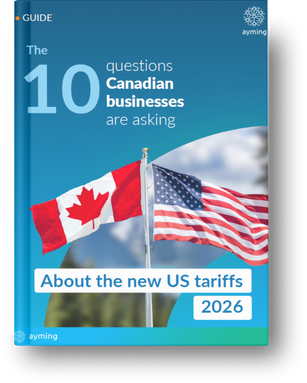
10 questions Canadian businesses are asking about the new US tariffs
US tariffs are reshaping the operating environment for Canadian businesses. New duties, Canadian counter-tariffs and evolving trade measures are increasing costs and uncertainty across multiple sectors, while governments are introducing new funding programs to help businesses manage the impact and adapt.
Understanding the New US Tariffs
- Significant tariffs are affecting Canadian goods: As of August 22, 2026, the US applies a 50% tariff to an estimated $27.6 billion of Canadian goods, including products in the automotive, agricultural, steel, aluminum, furniture and consumer goods sectors.
- Additional tariffs remain in place: A separate 10% Section 301 tariff applies to Canadian goods, although CUSMA-compliant goods are exempt.
- Canada has introduced counter-tariffs: Canada introduced 15%, 25% and 50% counter-tariffs on $27.6 billion of US goods, affecting sectors including steel, dairy, appliances, agricultural equipment and electronics.
- Billions in government support are available: The federal government announced a $7.5 billion package of new and enhanced measures, alongside nearly $25 billion in tariff-related support introduced previously.
- Smaller businesses can also access support: BDC’s minimum revenue requirement for tariff-related programs was lowered from $2 million to $1 million, while Quebec’s PAUPME program supports eligible businesses with revenue between $200,000 and $2 million.
How are US tariffs affecting Canadian businesses?
Tariffs can increase the cost of imported inputs, reduce margins and create disruption across supply chains. Businesses exporting to the US may also face additional duties depending on their products and applicable trade rules.
Companies should assess their specific tariff exposure and regularly review available government support as measures continue to change.
What funding is available?
Several federal and provincial programs can help businesses manage tariff-related pressure.
The Regional Tariff Response Initiative (RTRI) provides support for tariff-affected SMEs, including liquidity assistance and funding for investment or pivot projects. Other federal measures include BDC’s Pivot to Grow, the Canada Strong Diversification Fund and the Large Enterprise Tariff Loan.
Provincial programs may also be available, including Ontario’s Protect Ontario Financing Program and Quebec’s PAUPME and FORCE programs.
How can businesses respond?
Businesses can consider measures such as supplier diversification, new market development, automation and operational changes to reduce their exposure to tariffs.
Some adaptation projects may also qualify for SR&ED tax incentives where they involve systematic investigation to resolve genuine technological uncertainties.
Understanding both immediate funding needs and longer-term investment opportunities can help businesses respond to changing trade conditions.