

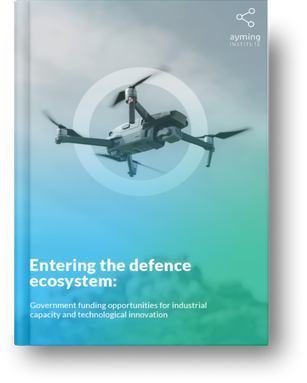
Entering the defence ecosystem: government funding opportunities for industrial capacity and technological innovation
Geopolitical disruption has pushed defence to the top of the national economic agenda. Governments across Europe and North America are ramping up spending on national security, supply chain sovereignty and military capability, and with it, opening new government funding routes for companies that have never before considered themselves part of the sector.
Ayming’s latest report shows how manufacturers, technology providers and dual-use innovators can reposition their capabilities, identify the funding mechanisms available to them, and understand what governments are prioritizing next.
Whether you already supply the defence value chain or are evaluating your first move into it, this report gives you a practical framework to assess where you fit and what funding could support your growth.
Funding instruments covered in this report
Beyond the global overview, Ayming’s Direct Funding experts break down the government support mechanisms most relevant to companies entering the defence value chain:
Accelerator funding
Support for dual-use testing, validation and market access as capabilities move toward deployment
R&D tax credits
SR&ED and equivalent experimental development incentives, generally horizontal rather than defence-specific
Demand-side instruments
Procurement and common purchasing mechanisms that shape national purchasing priorities and downstream demand
Private capital
How venture capital and private equity are opening up to defence and security as a strategic investment asset
Compliance readiness
Ownership, cyber maturity, certifications, export controls and supply-chain trust as entry conditions for funding
Canada's Defence Industrial Strategy
What the new BUILD-PARTNER-BUY framework means for domestic firms and future procurement decisions
What you’ll get from this report
-
Repositioning opportunities: How non-traditional defence companies can frame their existing capabilities to enter defence supply chains, even without prior sector experience.
-
Funding mechanisms across the value chain: A simplified breakdown of accelerator funding, R&D tax credits, and demand-side instruments such as procurement and common purchasing.
-
Innovation and industrial capacity: A practical framework for understanding which projects attract funding, from dual-use R&D to production scale-up, supplier qualification and market access.
-
Canada’s Defence Industrial Strategy: What the BUILD-PARTNER-BUY framework signals for domestic firms and future procurement.
-
Compliance and entry conditions: What companies need in place, from cyber maturity to export controls, before pursuing funding.
Download your free copy of Entering the Defence Ecosystem: Government Funding Opportunities for Industrial Capacity and Technological Innovation today and find out where your company fits in the value chain.
Our Government Funding specialists are ready to help you assess your eligibility, reach out today!
Get your free copy of the defence ecosystem report now!
See how to reposition your capabilities, identify the right funding mechanisms, and assess your fit within the defence value chain.
Frequently asked questions
Yes. Many companies already have dual-use capabilities in AI, cybersecurity, advanced manufacturing, energy or logistics that are relevant to defence and security objectives without being defence products themselves. The report outlines how to reframe existing civilian capabilities in defence and dual-use terms, and which entry route (grants, accelerators, prototype contracts or procurement-linked programmes) fits your stage of development.
Funding spans several categories: accelerator funding for dual-use testing and market access, R&D tax credits such as SR&ED for experimental development, and demand-side instruments like procurement and common purchasing that shape downstream market opportunities. Ayming Canada’s specialists help identify which combination applies to your projects and how to layer them without compliance risk.
Canada’s Defence Industrial Strategy introduces a BUILD-PARTNER-BUY framework. Under the BUILD pillar, future defence procurement in areas of domestic strength and sovereign capability will typically be directed to Canadian firms as a matter of policy: creating new opportunities for companies that can demonstrate relevant capacity, even outside traditional defence manufacturing.